When EY Ireland surveyed 200 senior sustainability leaders for its 2025 State of Sustainability report, one insight jumped out: 'community impact' has emerged as a leading area of strategic focus for Irish businesses, with 81% of respondents now prioritising it, ahead of climate risk, water stewardship, biodiversity and circular economy initiatives.
The "S" in Environmental, Social and Governance (ESG), long treated as the fuzzier, harder-to-measure sibling of the "E", has moved up the agenda in Irish boardrooms. The question now is how organisations in Ireland can turn their community impact commitments into something they can measure, manage, and report with confidence.
That's where Social Value comes in.
What is Social Value?
In the simplest terms, Social Value is the positive economic, social and environmental impact an organisation creates beyond its core commercial activity, business as usual, or legal baselines. For instance…
- A construction firm hiring local apprentices
- A facilities management company partnering with social enterprises in its supply chain
- A multinational employer running skills programmes in regional towns
These don’t show up on a profit and loss sheet, but they create real value for the communities, economies and environments they operate in.
Social Value is how you recognise that value, measure it, and use it as the basis for decisions. It overlaps with ESG (Environmental, Social, and Governance), but it isn't the same thing.
- ESG: largely asks ‘What risks does the outside world pose to the business, and what risks does the business pose to the outside world?’
- Social Value: Asks the inverse – ‘What positive benefit is the business creating for the outside world, and how much of it?’
A risk-focused ESG report can be technically compliant but leave a reader with no real sense of what good the company is doing. A Social Value report, done properly, answers that question directly, in numbers.
Why Social Value matters for businesses in Ireland
The strategic case for Social Value in Ireland rests on four pressures, all pointing in the same direction.
Boardrooms are already prioritising community impact
As already noted, 81% of Irish sustainability leaders rank it as their most important area of strategic focus. The ambition is there; what most organisations still need is the framework to back it up.
EU regulation is putting the S in ESG on a measurable footing
For Irish companies above €450 million in turnover and 1,000 employees, the Corporate Sustainability Reporting Directive will require sustainability disclosures under the European Sustainability Reporting Standards from financial year 2027. Four ESRS standards sit in the Social pillar: own workforce, workers in the value chain, affected communities, and consumers and end-users.
The Corporate Sustainability Due Diligence Directive adds ongoing human rights and environmental due diligence obligations from 2029 for companies above €1.5 billion turnover and 5,000 employees.
Public procurement is moving in the same direction
Circular 17/2025, published on 21 July 2025, made Green Public Procurement (GPP) binding for all public sector bodies with immediate effect. Its focus is environmental, but it also directs public bodies to consider social enterprises, voluntary and community organisations and requires government departments to report annually to the EPA on tenders awarded to those organisations where GPP criteria have been applied.
Greenwashing scepticism is reshaping how Irish businesses communicate
EY's research found 35% of Irish sustainability decision-makers now say fear of greenwashing accusations actively shapes their communication strategy: nearly triple the 13% who said the same in 2022.
The same scepticism is being applied to social claims. Generic statements no longer carry weight; specific, measurable, locally relevant impact does.
Together, these forces add up to a simple proposition: Irish businesses now need to be able to answer the question "What positive impact are we creating?" – credibly, consistently, and in numbers.
Measuring Social Value in Ireland: the TOM System
For a long time, Irish organisations had no consistent way to answer that question.
Activity could be described (apprenticeships, volunteering hours, community partnerships) but there was no shared framework for translating those activities into a coherent picture of total impact, and no agreed unit for comparing one organisation's contribution to another's.
The TOM System for Ireland was built to fill that gap. Developed by Social Value Portal, it's a standardised measurement framework designed specifically for organisations operating in Ireland, with Outcomes, Measures, and financialised values grounded in Irish data sources, Irish institutions, and Irish policy priorities.
It's structured around four themes:
- Work: Providing opportunities
- Economy: Driving inclusive growth
- Community: Empowering communities
- Planet: Environmental stewardship
Each Theme breaks down into Outcomes, and each Outcome into specific Measures an organisation can act on and report against.
It sits within the wider Global TOM System, which is the leading Social Value measurement standard internationally. Other versions are in use across Australia, Europe, and its place of origin, the UK, where the framework is trusted by over 200 government authorities and hundreds of businesses.
Why measure impact with financial values?
The defining feature of the TOM System is that every Measure has an associated financial value attached to it. A week of apprenticeship has a value. A long-term unemployed person moved into stable work has a value. A tonne of carbon dioxide (CO₂) avoided has a value.
Take the example of a "volunteering day" as an employee benefit. Using the Global TOM System for Ireland, the Social Value delivered by one day of volunteering can be quantified in monetary terms:
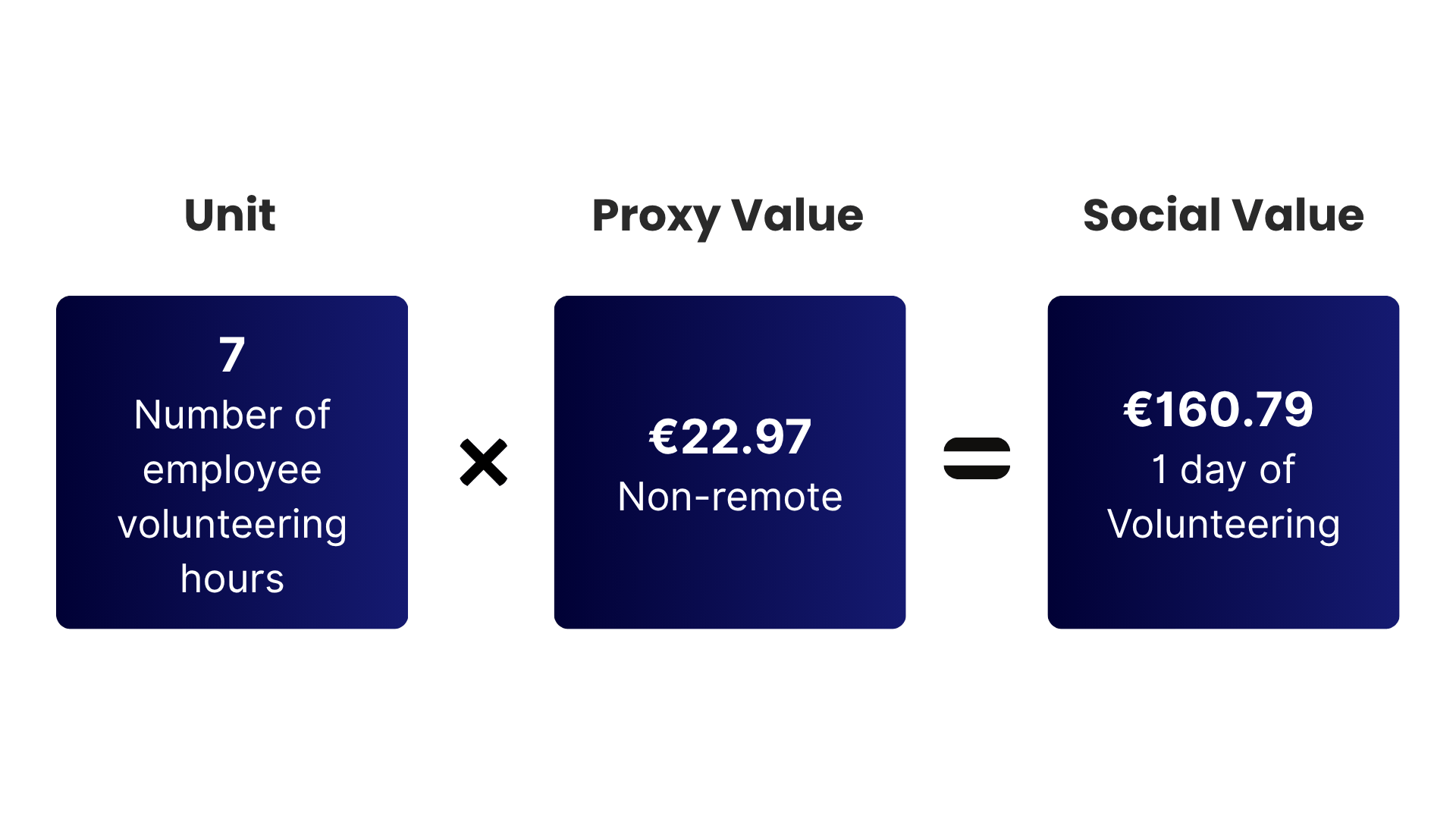
Multiply that proxy value across an organisation with 500 employees each taking one volunteering day a year, and the contribution becomes visible at a scale boards and finance teams can engage with: €80,000+ of measurable Social Value, captured in the same language as any other line in the business.
Each proxy value is calculated by a team of researchers, economists, and social scientists, drawing on data from organisations like the European Commission, the International Labour Organisation (ILO), and the United Nations Office on Drugs and Crime (UNODC), alongside country-specific sources such as Ireland's Central Statistics Office (CSO), Transport Infrastructure Ireland (TII), and the Charities Regulatory Authority.
The financial proxy makes year-on-year progress trackable, and lets organisations benchmark contracts, locations, and business units on a like-for-like basis. And most importantly, it integrates Social Value into core business decisions rather than confining it to a separate reporting exercise.
Where to go from here
Community impact is now the top sustainability priority in Irish boardrooms, public procurement is moving in the same direction, and Irish consumers and investors are sharper than ever at distinguishing real impact from social washing.
The organisations getting ahead of this aren't waiting for further legislation to force their hand; they're investing in their measurement capabilities now.
Learn how the TOM System for Ireland could help your business get ahead of the curve.
.svg)