On 5 August 2026 the Government published Procurement Policy Note (PPN) 026 and, with it, a new Social Value Model. It takes effect for central government procurements started on or after 1 January 2027, and changes what Social Value means on those contracts.
Reactions have been loud and split. This article sets out what the PPN changes, and shares highlights from the briefing we hosted with a panel of experts from across sectors.
In this article:
- Understanding PPN 026
- The new Social Value Model: Outcomes and Model Award Criteria
- How thresholds, weightings, and KPIs have changed
- What we still don't know
- How the sector is reacting
- Where this leaves serious Social Value practitioners
Understanding PPN 026
The new Social Value Model is the third in under two years, replacing the Model that arrived with PPN 002 in February 2025 (becoming mandatory in October 2025) for procurements started on or after 1 January 2027.
Who does it apply to? Central government departments, their executive agencies and non-departmental public bodies. Private utilities contracts are excluded, as are procurements whose primary purpose is overseas delivery.
Local government, the NHS, schools and colleges, and housing providers are not in scope and are under no obligation to adopt the Model. They continue under the broader duty in the Public Services (Social Value) Act 2012, the Procurement Act 2023, and the National Procurement Policy Statement.
Which contracts? Only covered procurements with a total contract value of £1m or more, including VAT. Below that line the Model does not apply at all, a significant change from PPN 002, which applied at the standard above-threshold level (currently £135,018 inclusive of VAT) and so caught a far larger population of contracts.
From when? Procurements commenced on or after 1 January 2027, where commenced means the date the tender notice is published rather than the date of award. Anything procured between October 2025 and then will run under PPN 002. Departments already mid-procurement are encouraged to move across, but may stay with the previous edition where switching "would require disproportionate resources or invalidate previous market engagement activities."
💡 Our webinar on PPN 026 included a detailed breakdown: Watch it here
The new Social Value Model: Outcomes and Model Award Criteria
Announcing the change, First Secretary of State Louise Haigh said, "the £90 billion that is spent each year through government contracts supports British jobs, skills and people in every postcode."
But while the ambition is big, the parameters are much narrower than the old Model.
The Five Missions structure that organised PPN 002 has gone entirely, and so have the eight Policy Outcomes. In their place sit two Outcomes, each with three Model Award Criteria.
|
Outcome
|
Model Award Criteria
|
|
1. Good Jobs
|
1a. Create and/or retain high quality jobs: Generating or maintaining roles in relevant areas, adapting recruitment to widen community access, developing roles in innovative sectors
1b. Fair working conditions: Conditions exceeding statutory minimums, support for workers facing employment barriers, union access, flexible working, wellbeing provision
1c. Fair pay: Pay above national minimum wage requirements and progressive remuneration
|
|
2. Skills
|
2a. Training / retraining: Addressing skills shortages and supporting disadvantaged groups through co-designed apprenticeships and placements
2b. In-work progression: Career advancement pathways that improve retention and service consistency
2c. Talent pipeline: Identifying potential in communities and enabling pre-employment training, apprenticeships and educational routes
|
💡 Read PPN 026
Underneath each Outcome sit Objectives, and they are structured differently for each.
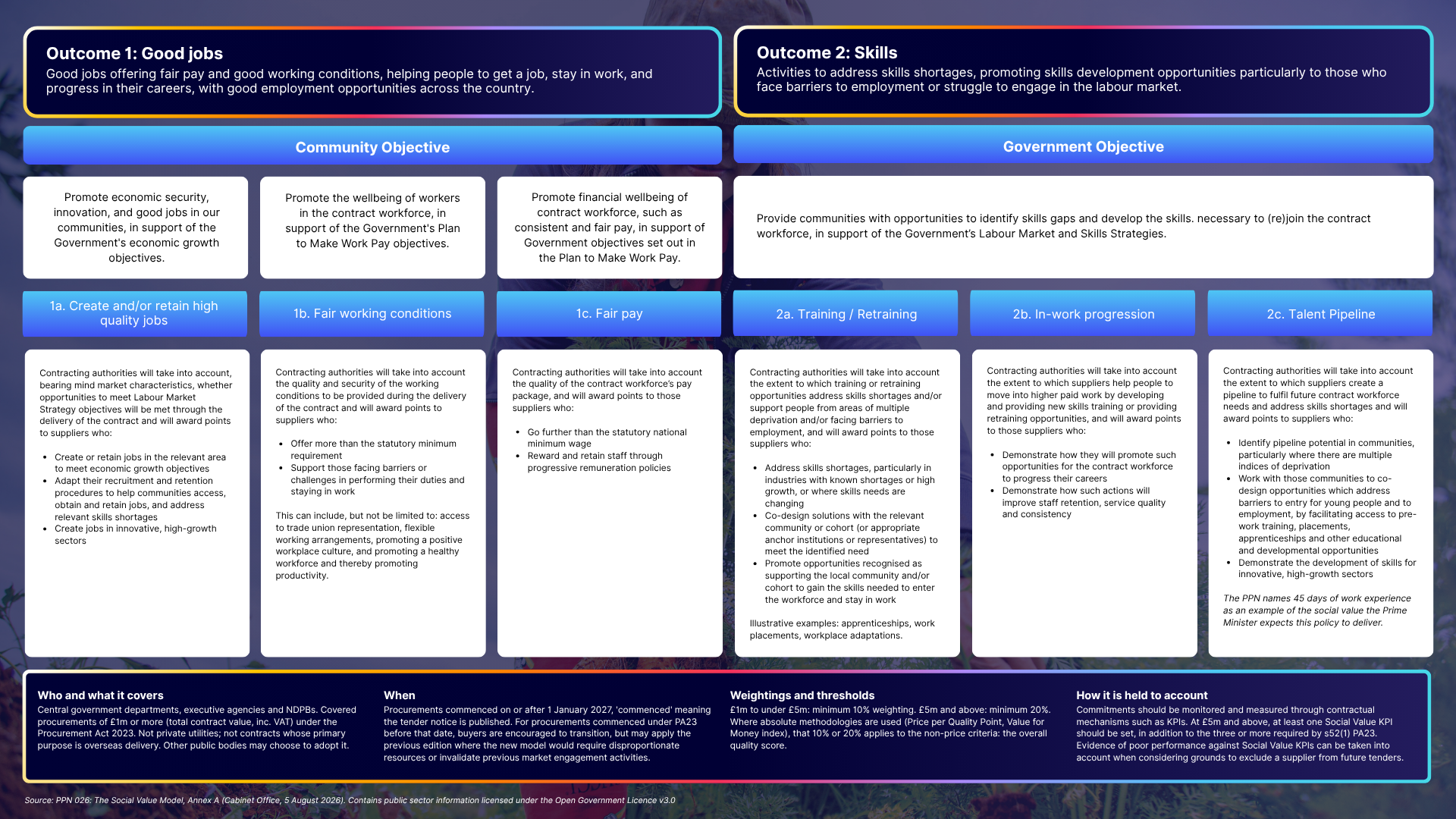
Good Jobs carries three Community Objectives, one against each MAC:
- 1a: Promote economic security, innovation, and good jobs in our communities in support of the Government's economic growth objectives.
- 1b: Promote the wellbeing of workers in the contract workforce in support of the Government's Plan to Make Work Pay objectives.
- 1c: Promoting the financial wellbeing of the contract workforce, such as consistent and fair pay, in support of the Government's objectives set out in the Plan to Make Work Pay.
Skills carries a single Government Objective covering all three of its MACs:
- 2a, 2b and 2c: Provide communities with opportunities to identify skills gaps and develop the skills necessary to (re)join the contract workforce.
What’s clear from this is that this Social Value Model is (to a much greater extent than PPN 002) designed to serve as a delivery route for industrial and employment policy.
💡Below: PPN 026 on a page
What’s gone from the Social Value Model
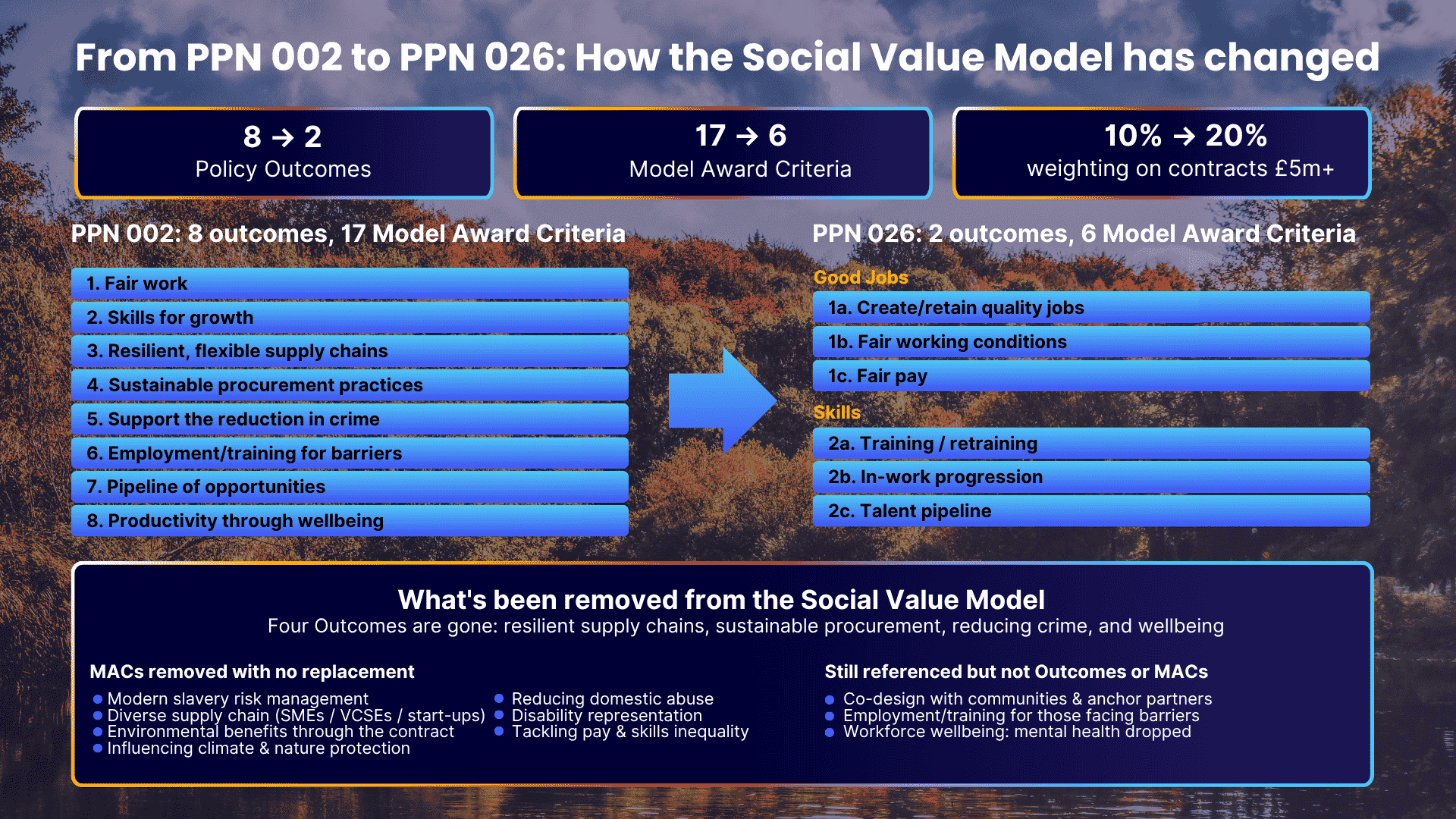
PPN 002 had 17 Model Award Criteria across eight Policy Outcomes, while PPN 026 has six across two. Four Outcomes are gone:
- Resilient, innovative and flexible supply chains
- Sustainable procurement practices
- Support the reduction in crime
- Increasing productivity through physical and mental wellbeing
All six MACs in PPN 026 trace back to the old Model.
Good Jobs takes its three directly from the Fair work Outcome: create and retain high-quality jobs (now "create and/or retain") fair working conditions, and fair pay practices (now simply "Fair pay").
Under Skills, training / retraining comes from the old learning and skills development MAC. In-work progression is lifted out of Fair work and moved here, and talent pipeline merges the two MACs that covered removing barriers to entry for young people and under-represented groups, and building a pipeline for the future contract workforce.
However, seven MACs are gone with no replacement:
- Identifying and managing the risks of modern slavery
- Creating a diverse supply chain including start-ups, SMEs, VCSEs and mutuals
- Delivering additional environmental benefits in the performance of the contract
- Influencing staff, suppliers, customers and communities to support climate and nature protection
- Reducing domestic abuse
- Increasing the representation of disabled people
- Tackling inequality in employment, skills and pay
Three of PPN 002's MACs are no longer MACs under PPN 026, but are referenced in the summary text under the new MACs:
- Co-design with communities and anchor partners
- Employment and training for those facing barriers
- Workforce health and wellbeing, though only as "promoting a healthy workforce". Mental health is not referenced anywhere in the new Model
PPN 026 also introduces a "Resource for bidders: List of Community Programmes" that will accompany the Model. What is on it, how it is compiled, and whether bidding against it is expected, remains unknown. The Cabinet Office also says it will "develop guidance to support procurement teams intending to take into account existing, inherent social value".
How thresholds, weightings, and KPIs have changed
Where a contract is in scope, exactly what the authority and supplier have to do depends on the contract’s value. Two figures are especially important: £1m and £5m.
|
Total contract value (inc VAT)
|
Social Value weighting
|
Social Value KPI
|
|
Below £1m
|
Model does not apply
|
--
|
|
£1m to under £5m
|
Minimum 10%
|
Not required by the PPN
|
|
£5m and above
|
Minimum 20%
|
At least one, published
|
PPN 026 introduces two important changes to the weightings and thresholds of in-scope contracts.
- The weighting is now banded by value: Under PPN 002 every in-scope contract carried the same requirement: in-scope organisations "must apply a minimum 10% weighting (or an equivalent measurement) of the total score, for social value". The figure did not change with contract size. PPN 026 keeps 10% as the minimum from £1m to under £5m, but doubles it to 20% above £5m.
- Many lower-value contracts are now out of scope: PPN 002 applied to above-threshold covered procurements (for central government goods and services, currently £135,018 inclusive of VAT), while PPN 026 applies only at £1m and above. For supplies and services, this takes a large volume of contracts out of scope. Works are unaffected, since a pure works contract only becomes a covered procurement at £5,193,000; since every works contract that is in-scope sits above £5m, all should carry the 20% weighting and at least one Social Value KPI..
Social Value KPIs
PPN 002 already stated that all Social Value commitments made during a procurement “must be reflected in the contract either as contract terms, key performance indicators, or performance indicators”.
PPN 026 changes the mechanism for contracts of £5m or more, where at least one Social Value KPI should now be set, in addition to the three or more KPIs already required by section 52(1) of the Procurement Act 2023 (though those under the Procurement Act 2023 were not necessarily Social Value-related). This will significantly increase visibility of performance, since delivery against at least one Social Value KPI on large central government contracts will now become a matter of public record.
Exclusion provisions
PPN 026 also states that "evidence of poor performance against social value KPIs can be taken into account in considering whether there are grounds to exclude suppliers from bidding for future tenders."
That arguably connects Social Value delivery to the Procurement Act's existing framework for poor performance and supplier exclusion. Suppliers must treat this as a real risk.
What we still don't know
Under PPN 002, the Social Value Model was a framework plus a substantial guidance document setting out sub criteria, evaluation detail and metrics. Comparable guidance for PPN 026 will be published in autumn 2026.
Here are some of the issues that are currently unresolved and require further guidance:
- How evaluation and delivery will be measured. PPN 026 makes no reference to Standard Reporting Metrics. Whether the SRM set survives or gets replaced is unknown. Nor do we know whether evaluation will stay qualitative, as under the Model Social Value Question, or move toward something quantified.
- Whether the National Procurement Policy Statement changes. The NPPS shapes expectations across the whole public sector, not just central government, and hasn’t been changed to match the narrowed Model.
- Whether the adjacent PPNs will be realigned. PPN 001 still requires in-scope bodies to set direct SME targets (indirect being voluntary) and PPN 024, published in June, still references PPN 002 in its public interest test. These PPNs remain live and continue to drive some of the priorities removed from the scope of the Social Value Model.
How the sector is reacting
Shortly after the publication of PPN 026, we brought together four practitioners to work through it in a webinar:
- Sarah Stone, founder of Samtaler
- Peter Smith, procurement consultant, past president of CIPS and author of Bad Buying
- Emily Davies, ESG Director at Amey
- Darren Knowd, CEO of DRKNOWD Limited, previously Head of Procurement, Sales and Business Services at Durham Council and Chair of the National Social Value Taskforce
- Guy Battle, CEO of Social Value Portal
Over a thousand people registered for the session within a week. The session asked the panel a simple question:
Is this change good for Social Value?
Amey’s Emily Davies (whose company was among the contractors quoted supporting the change in the government's announcement) largely supported the changes from the supplier side, arguing that the old Model was built around Missions that no longer exist, that several of its areas were never seriously evaluated in practice, and that the questions Amey already saw in bids were already largely about jobs and skills.
We do like simplification. Who doesn't? It helps focus the mind and will force us to be a bit more creative in how we're providing those opportunities.
Emily Davies, ESG Director at Amey
She was also clear, however, that the removed themes would not be dropped at Amey, because other mechanisms cover them: volunteering as employee engagement, environmental commitments driven partly by investors, and strong relationships with SME and third sector organisations.
She also pointed to the cohorts PPN 026 names (NEETs, people moving from education into work, those with a long-term health condition or disability, and care leavers) and argued the KPI needs to capture how a supplier goes about reaching them rather than output numbers alone.
Peter Smith, meanwhile, argued that the change was primarily politically driven and argued the higher weighting arrives without evidence that the previous one worked.
At 10% it matters, but it's not a matter of life and death. At 20%, it's getting really significant.
Peter Smith, procurement consultant, past president of CIPS and author of Bad Buying
His practical concern was comparability and verification: how an evaluator ranks a bid offering 100 minimum wage jobs against one offering 50 better-paid ones against one offering to upskill its entire workforce and take on care leavers as apprentices, and how any of it gets checked afterwards.
The session’s chair, Guy Battle, was concerned by the areas excluded from PPN 026, and the risk that organisations could drop them.
A lot of organisations I work with have thought about the triple bottom line. Environment is there, supporting communities is there, diversity of supply – all those things that have now come out. Does this mean a business says, forget the environment?
Guy Battle, CEO, Social Value Portal
Darren Knowd named the KPI as the single gain, while arguing that weighting jobs and skills more heavily within a broad, quantified model would have achieved the same end without the losses.
Calling it a Social Value PPN model is probably not the best description. It's actually a policy about employment and skills.
Darren Knowd, CEO of DRKNOWD Limited
However, he argued that PPN 026 will largely be ignored by the majority of the public sector other than central government departments. His larger concern relates to implications for the National Procurement Policy Statement, which is as yet unchanged, but if altered in line with PPN 026, would if have a larger impact on Social Value practice in procurement.
Sarah Stone of Samtaler welcomed the £1m threshold taking smaller contracts, but was concerned by what organisations might conclude from the Model's narrowed thematic scope, particularly around environment.
[They need to] do something about saying that environment is still important to us, SMEs are still important to us… If they don't clarify that, then I think that could be really bad. It could set us back years. And the messaging that boards are going to receive is, oh, this doesn't matter. And it does.
Sarah Stone, founder of Samtaler
Crucially, Sarah also noted that delivery has never really been limited by supplier intent, but by commercial teams' capacity to manage it, a problem that will persist after PPN 026.
One caveat ran under the whole discussion. What has been published is the framework; the guidance explaining how it will be applied is not due until the autumn, and much of what the panel disagreed about turns on what that document says.
Where this leaves serious Social Value practitioners
PPN 026 tells us what central government will score as Social Value from January 2027, but it does not tell us what Social Value fundamentally is, for you and for the communities you interact with.
In reality, organisations will need to form their own Social Value priorities based on multiple inputs:
- PPN 06/20 on contracts and frameworks let between January 2021 and October 2025
- PPN 002 on anything procured from October 2025 until the end of 2026
- PPN 026 on new central government work above £1m from January 2027
- The broader duty that continues to apply in local government, health, housing and education
- Just as important: your own commitments, your investors' expectations, and the communities you already work with
Three things follow for anyone preparing now, while the guidance is outstanding.
- Build your Social Value strategy around stakeholder needs. A strategy built purely to respond to the latest PPN will probably remain surface-level. A strategy built around what your communities need and your stakeholders expect, will still stay relevant for years to come while serving your strategic priorities.
- Measure Social Value properly, from commitment to delivery. Whatever the autumn guidance requires, you will be in a stronger position if you can show what you’ve already delivered. That is far easier if you already have a measurement framework in place. The Social Value TOM System™ was built to measure the full spectrum of Social Value activity while also mapping to the Social Value Model and other impact reporting standards.
- Get your delivery independently validated, and start now. Under PPN 026, Social Value performance on the largest contracts becomes a published, annually reported figure, and poor performance can be weighed when authorities consider future exclusions. That makes a third-party validated track record a huge asset.
If you're looking for a Social Value measurement and reporting solution that meets compliance standards and flexes to your unique needs, speak to the team today.
.png)

.svg)