The Bread and Butter Thing is the UK's largest member-based food charity. It runs weekly affordable food clubs in 159 communities across 34 local authority areas, redistributing surplus that would otherwise be thrown away.
In 2025 it unlocked nearly 10,000 tonnes of food and distributed the equivalent of 21 million meals.
We bring healthy, affordable food right into the heart of communities, week after week. That regular presence means we can do much more than help people stretch their food budgets. We build relationships, create connection and reach people before pressure turns into crisis.
Vic Harper, Chief Executive, The Bread and Butter Thing
A thousand community volunteers turn out each week, contributing 183,000 hours a year and building their own confidence and friendships in the process. More than 200 partner organisations, including Citizens Advice, provide face to face support at Bread and Butter hubs. Through its Big Brew Time scheme, TBBT gives members free hot drinks and somewhere to sit while they wait for their bags.
For many members, that is a big reason they keep coming back: neighbours become friends, volunteers and members catch up, and someone who might have spent the day alone spends part of it in company.
.png?width=1920&height=1080&name=SVP-Webinar-Blank-Banner-Impact%20(2).png)
In our recent webinar, we hosted Vic Harper, CEO of The Bread and Butter Thing, alongside Social Value Portal experts, to explore what makes social impact measurement meaningful.
Watch the free on-demand session now.
Why TBBT came to Social Value Portal
The Bread and Butter Thing wanted a monetised figure for its impact, calculated independently rather than by TBBT itself, using a methodology that would hold up under scrutiny. The organisation also wanted the figure for internal use, to see clearly which parts of the charity's work create the most benefit.
The charity was not short of member feedback. Its annual survey draws around 9,000 responses in a week across roughly 70 questions. What that feedback could not do was put a value on the change it described, particularly for the less tangible parts of the work like company and confidence.
We can say 92% of people eat better because they shop with Bread and Butter. But it doesn't really quantify what that means for people. And it doesn't help us have a conversation with funders or government or local authorities.
Vic Harper, Chief Executive, The Bread and Butter Thing
Most organisations we work with use the Social Value TOM System™, reporting their activities against a standard set of Measures, with the results validated on our platform.
Each Measure carries a proxy value: a financial figure, drawn from official statistics and government guidance, representing what that outcome is worth to the person, their community and the public purse. Those values are built to hold true across thousands of different contracts, which is what makes them usable at scale.
TBBT wanted to go further than a standard set of Measures and understand its own model in depth, so we ran a bespoke Social Impact Evaluation and built the values from scratch.
How we measured The Bread and Butter Thing’s impact
We began with a Theory of Change, which is the evidenced chain that links what an organisation puts in to what actually changes for the people it serves. Mapping that chain for the food clubs told us which outcomes were genuinely TBBT's to claim, and therefore which data mattered.
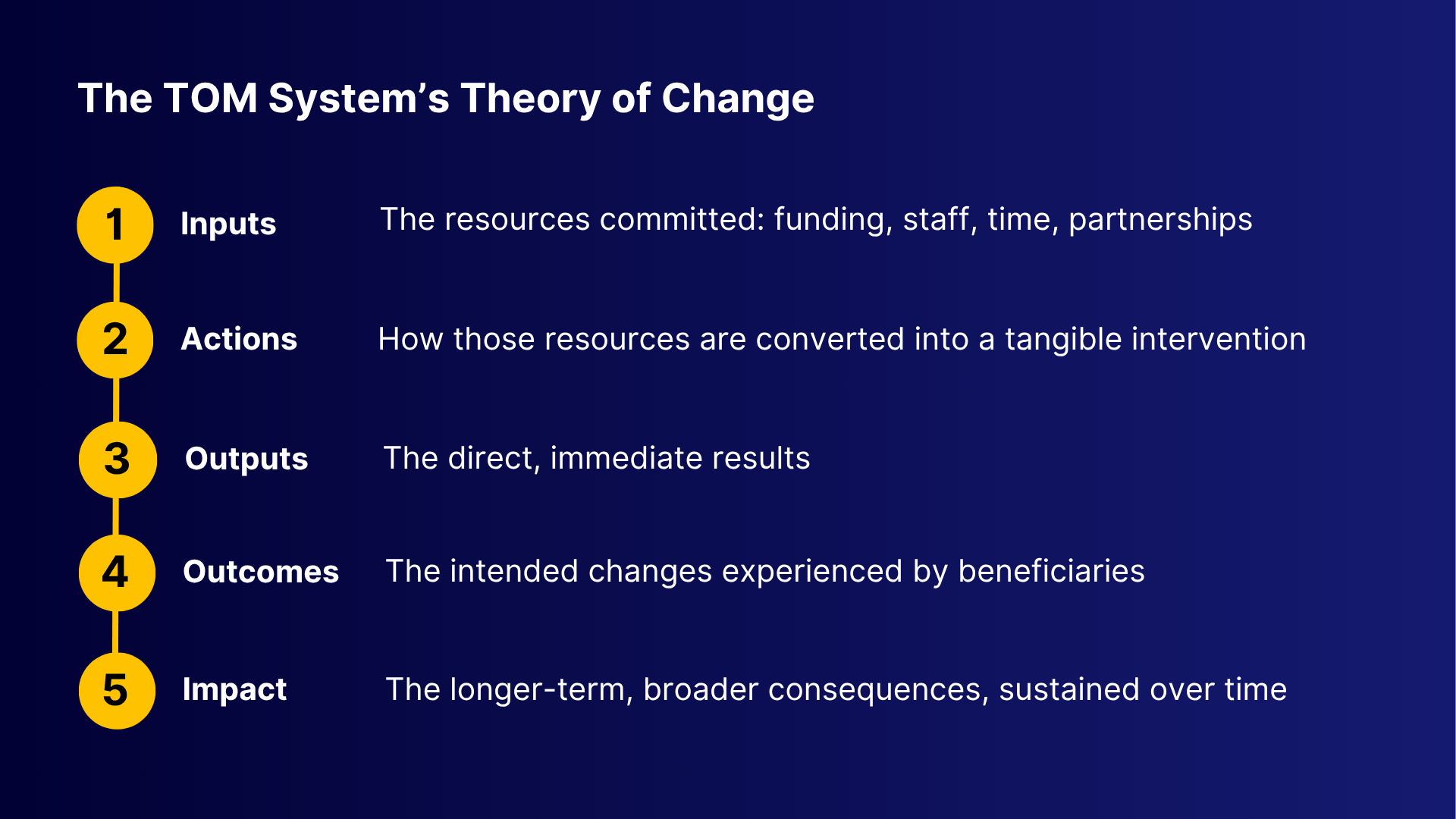
We then combined TBBT's basket savings data across more than 30,000 unique members with a survey of nearly 8,700 of them, alongside evidence from academic literature, HM Treasury guidance, and ONS, NHS, BAPEN and Trussell Trust data.
Our approach to determining which member responses could reasonably be attributed to TBBT was deliberately conservative. Members rated statements about their experience on a scale of one to ten, covering outcomes such as saving money, improving their diet and reducing social isolation.
Rather than selecting an arbitrary cut-off, we carried out sensitivity analysis across different response thresholds to understand how the estimated impact changed as the attribution criteria became more stringent. This analysis informed the decision to include scores of nine and ten, providing a conservative threshold for identifying outcomes that could most confidently be associated with TBBT. For outcomes expected to require sustained engagement, we also applied a minimum participation threshold of 36 weeks within the year.
We then applied additional adjustments to avoid overstating the impact. Where appropriate, we used deadweight to account for outcomes that may have occurred without TBBT. The valuation framework was designed to avoid overlap between related outcomes – particularly important where different reported benefits could capture elements of the same underlying wellbeing improvement – ensuring that the same impact was not valued more than once.
The responses that met those criteria were then valued across four areas of benefit, each with its own evidence base:
|
Value block
|
How we built it
|
|
Income
|
Basket savings, weighted so that money saved counts for more in a low-income household, following the Green Book
|
|
Wellbeing
|
Trussell Trust evidence that food-insecure people report lower life satisfaction, monetised through the WELLBY framework
|
|
Malnutrition
|
BAPEN's evidence on what malnutrition costs the public purse per person each year
|
|
Loneliness
|
The Loneliness Monetisation Report's evidence on reduced productivity among lonely workers, applied only to working-age members to avoid double-counting wellbeing
|
Money saved on a food shop, a rise in life satisfaction and a reduction in the cost of malnutrition to the NHS are not naturally comparable. The SV£ works like a currency for impact, pricing each benefit in pounds using published evidence so that benefits of very different kinds can be added together and set against what it cost to create them.
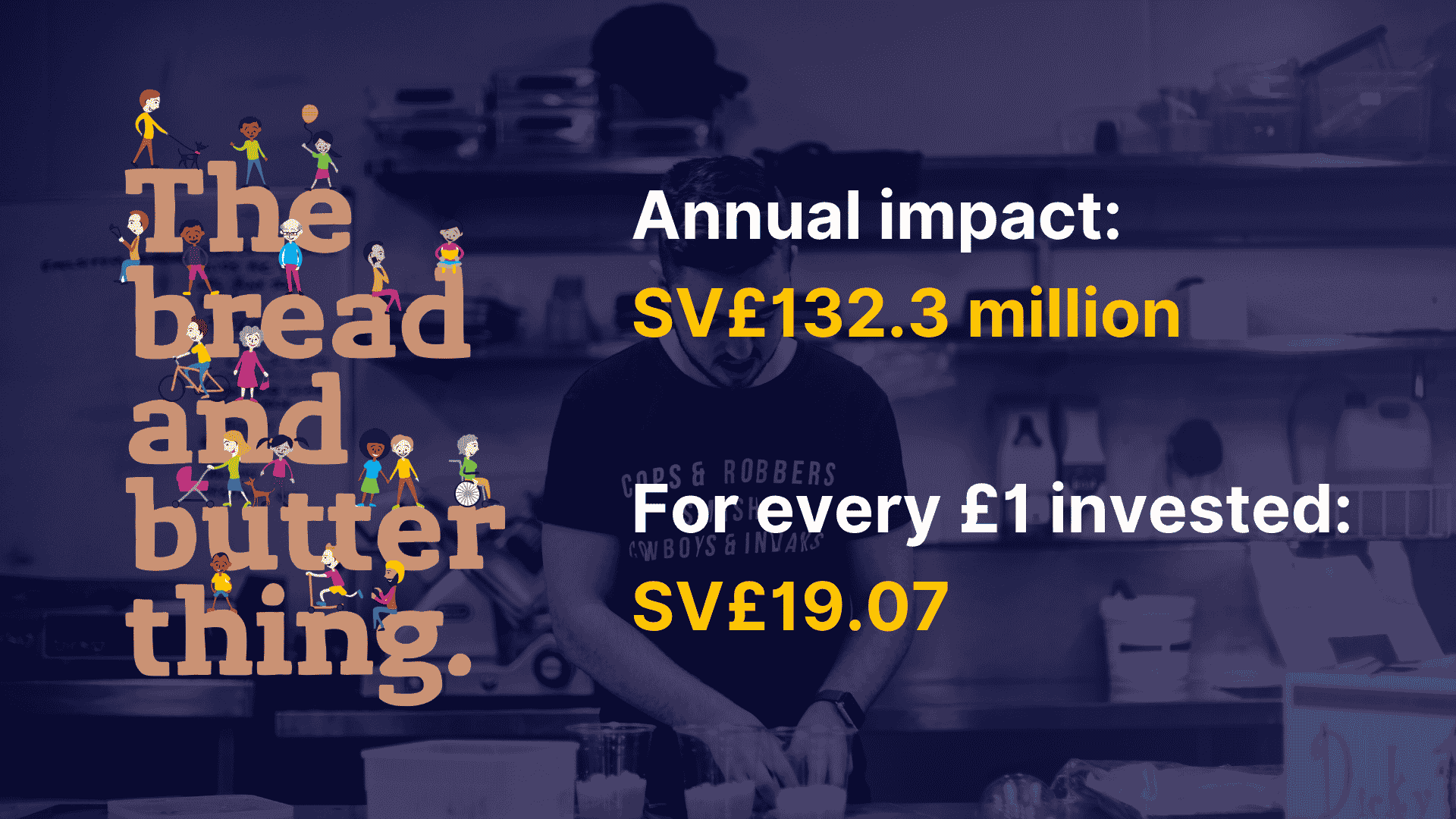
TBBT's annual impact comes to SV£132.3 million, or SV£19.07 for every £1 invested. The evaluation gives TBBT an independently calculated measure of its impact, and it shows the charity internally which of its activities do the most for members.
I can trust that that figure is credible, that it's got the maths behind it. If someone was to chip away at it and try and challenge it, it's all totally legitimate in terms of how it's being calculated. Which means I can talk to it with even more pride and even more confidence.
Vic Harper, Chief Executive, The Bread and Butter Thing
Measuring your own impact
The full methodology behind this evaluation is in our report, The difference between box-ticking and real impact, alongside an explanation of how the TOM System turns activity into measured impact.
If you want to understand the difference your own work makes to the people it reaches, get in touch with our team.
And to learn more about the work of The Bread and Butter Thing, explore their website.

.svg)