A difficult job market has long been a challenge in the UK: the economic inactivity rate for working-age people has held at around one in five for over a year, according to the Office for National Statistics, with more than 9 million people out of the labour force.
For some groups, that challenge runs deeper. For people with a criminal record, care experience, experience of homelessness, or a background in the armed forces, finding work has never been a level playing field. Whatever the wider economic conditions, these groups are disproportionately screened out before they're ever seen, not because of ability, but because of who they are on paper.
Understanding the challenge
Among veterans, more than half report taking a job below their previous level of responsibility or skill. Around 40% of care leavers aged 19-21 are not in education, employment or training, compared with around 13% of their peers, while government-backed research found 93% of people with recent experience of street homelessness were unemployed despite most having worked before. Every statistic points to the same reality: capable, work-ready people are too often locked out of opportunity.
The cost of that isn't just personal. Ministry of Justice figures show fewer than one in five people who are in employment six weeks after leaving prison go on to reoffend, compared with almost double that rate among those who remain unemployed, and the Public Accounts Committee estimates the cost of reoffending to the UK at around £20.9 billion a year. Every year, employers miss out on a source of loyal, motivated talent, while communities and public services bear the consequences of barriers that need not exist.
Helping people into good work is now a clear priority in public procurement. A revised Social Value Model for central government was published by the Cabinet Office in August 2026. Procurement Policy Note 026 (PPN 026) is centred on good jobs and skills, with a particular focus on people facing barriers to employment sets out. For procurements commencing from 1 January 2027, central government buyers are expected to give Social Value a minimum weighting of 10% when evaluating contracts worth £1 million or more, rising to 20% for contracts worth £5 million or above. Care leavers are among the target cohorts the note identifies, with further guidance to follow in autumn 2026.
The message is clear: creating fair routes into work for the people who need them most is now a core part of how central government contracts are evaluated.
This spotlight looks at how Serco's Pathways programme is tackling these barriers head-on through supported routes into employment – generating benefits to people, communities and the public purse in the process.
What is Pathways?
Pathways is Serco's commitment to creating fair, supported, and sustainable routes into employment for people who face structural barriers to work: people with criminal justice experience, military veterans and their families, care-experienced individuals, and people with experience of homelessness.
It works through guaranteed interviews, risk-informed vetting, mentoring and tailored training.
- Anyone who opts in and meets the minimum criteria for a role is guaranteed an interview.
- A 'Ban the Box' policy means criminal convictions don’t need to be disclosed at application stage, stopping people being screened out before they're seen.
- Risk-informed vetting ensures all candidates are appropriately assessed and managed against robust safeguards.
- Once someone is hired, Pathways provides tailored training and ongoing mentoring in the role.
Serco’s Pathways programme is built on 2 principles: employer policy and lived experience mentoring with a broad network of 25+ specialist recruitment partners, each covering a different cohort.
💡Learn more about Pathways
Serco’s strategic social recruitment partners for Pathways
Serco knows that reaching the people who face the biggest barriers to work takes specialist expertise it doesn’t hold in-house. That’s why Pathways is built strategically around a network of 25+ social recruitment partners, each bringing deep, trusted knowledge of a specific cohort’s needs. Working with these partners is a deliberate choice: it lets Serco combine its scale as an employer with the sector expertise needed to turn guaranteed interviews and risk-informed vetting into real, sustained hires.
People with criminal records
Offploy is their core strategic partner, shaping the risk-informed vetting reforms behind Ban the Box. Alongside it, Serco works with Working Chance who focus specifically on women with convictions, Key4Life which supports young men leaving prison through rehabilitation and mentoring, and Clean Sheet, No Going Back, and Beating Time who run their own initiatives.
Veterans, reservists and their families
Walking With The Wounded helps candidates with military experience into civilian roles, while Forces Transition Group and Recruit for Spouses extend that reach further, the latter specifically supporting partners and families of serving personnel facing their own employment instability.
People with experience of homelessness
Standing Tall, a national homelessness employment charity backed by Serco Foundation funding, has enabled Serco achieve multiple hires in this cohort and provides the pastoral support to maintain strong retention.
Care-experienced individuals
Serco supports care leavers into employment through guaranteed interviews, constructive feedback, and workplace mentoring. As a signatory of the Care Leavers Covenant and the Care Leaver Friendly Employer Charter, they offer these opportunities to care-experienced applicants who meet the minimum criteria, supported by a buddy scheme designed with colleagues who have lived care experience.
What Pathways has delivered to date
Pathways has supported 397 people into employment since it was launched in Q4 2025:
- 139 people with criminal records
- 245 military leavers, veterans and family members
- 13 people with experience of homelessness
Serco measures the impact of Pathways using Social Value Portal's TOM System™, the UK's leading framework for measuring Social Value.
If these 397 people remain in their roles for a year, with data validated by Social Value Portal, the programme will have generated £19,523,164 in Social Value. With mentoring and development support built in, the roles are designed to be worth staying in, not just starting.
Measuring the Social Value of Pathways
The TOM System proxy values that Serco uses to measure its impact are built using data from the Office for National Statistics, the Department for Work and Pensions and HM Treasury's Green Book. Each proxy is made up of value blocks that capture:
- Benefit to the individual
- Benefit to the community
- Benefit to society
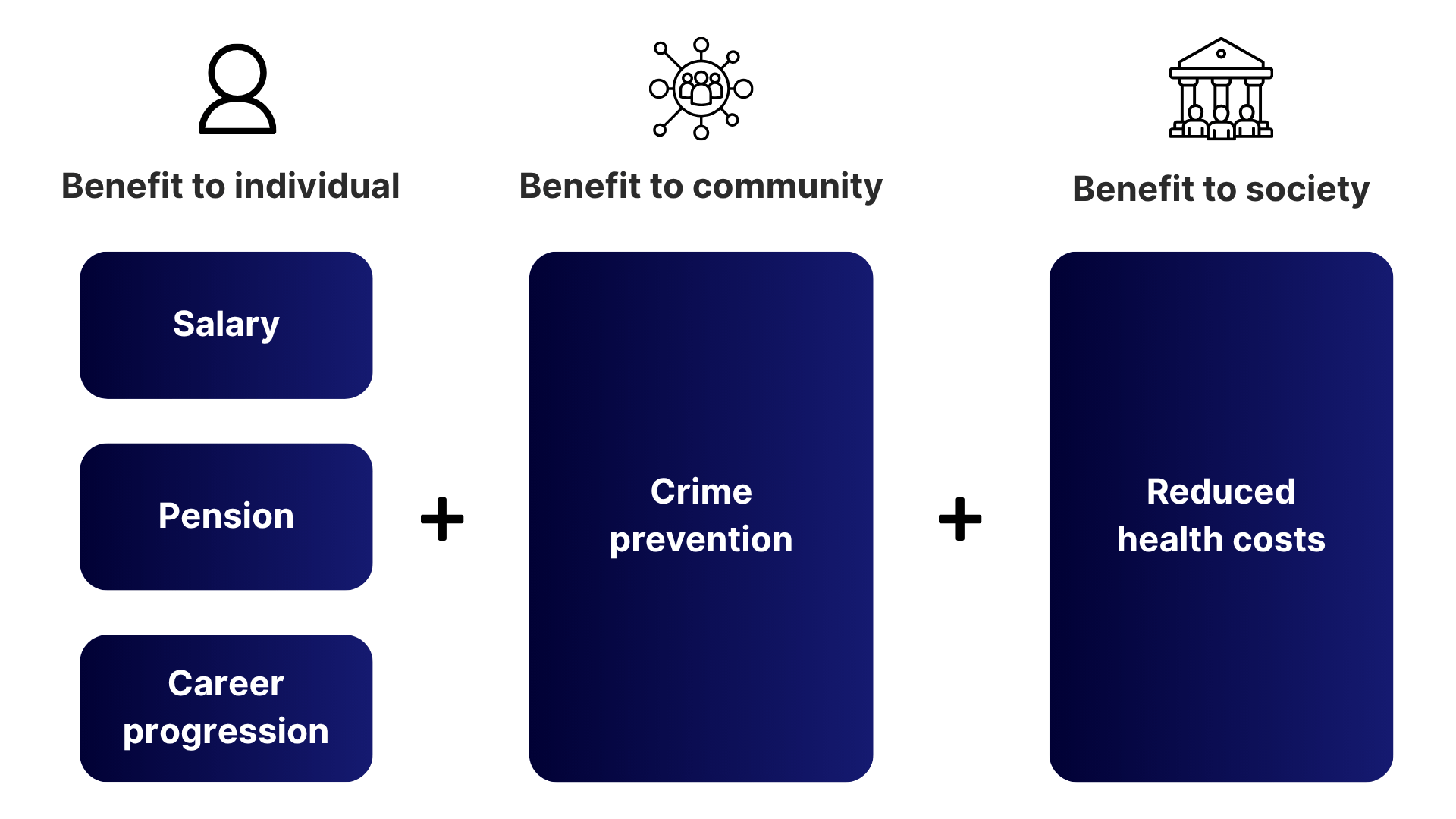
Example of value blocks within a TOM System Measure
To ensure an accurate value claim that does not overstate delivery, every proxy value is adjusted to account for:
- Attribution: The share of an outcome an organisation can genuinely claim
- Deadweight: The portion that would have happened anyway
- Drop-off: The reduction in benefit over time as effects fade).
- Leakage: The share of benefit that flows outside the target population or area - included in the outcome but not in the value attributed to the intervention.
Ultimately the proxy value captures not only the immediate effects of hiring a person facing barriers to work, but also the ripple effects for the community and society.
When an ex-offender finds work, for example, the benefit doesn't stop at the wage: it stimulates local economic activity, creates additional tax revenue, and reduced pressure on an already stretched criminal justice and prison system as reoffending risk falls.
This is especially important for Serco, a strategic supplier to central government. Pathways isn't only a Social Value story for the people it hires. With the Government's new PPN 026 Social Value Model putting good jobs and skills for people facing barriers to employment at the centre of how major contracts are evaluated, it's also a live example of how Serco helps government meet its own policy objectives.
Every hire counts
Ten month and 397 hires in, Pathways is delivering real roles at Serco and across its supply chain, filled by people who might otherwise have been screened out before they ever got an interview, backed by mentoring to help them thrive.
Serco is proving there's a better way to hire.


.svg)